The machines: differences and a few details
The three machines are genuinely different, in ways that change what a circuit even looks like. Please check the following table for details, and the white paper on Zenodo.
Euro-Q-Exa |
VLQ |
Piast-Q |
|
|---|---|---|---|
Technology |
Superconducting |
Superconducting |
Trapped ion |
Qubits available |
54 |
24 |
20 |
Connectivity |
Square lattice |
Star, through one resonator |
All to all |
Native gates |
|
|
|
What you send |
An abstract circuit; the site maps it |
Native gates, mapped to physical qubits |
Native gates, mapped to physical qubits |
Authentication |
Bearer token from a portal |
Federated identity token |
API key header |
Time is billed in |
Wall-clock QPU seconds |
Device execution time |
Device time, including ion loading |
Access shape |
One REST call |
Two jobs |
One REST call |
The row that matters most is what you send. On Euro-Q-Exa you can send an abstract circuit and the site maps it for you. On the other two you must send native gates, already mapped to physical qubits. The same Bell pair is three different objects.
Note
The billing row is expanded in “QPU hours” on the devices. How the machines sit alongside classical HPC is in HPC and HPC-QC.
What you send, and where
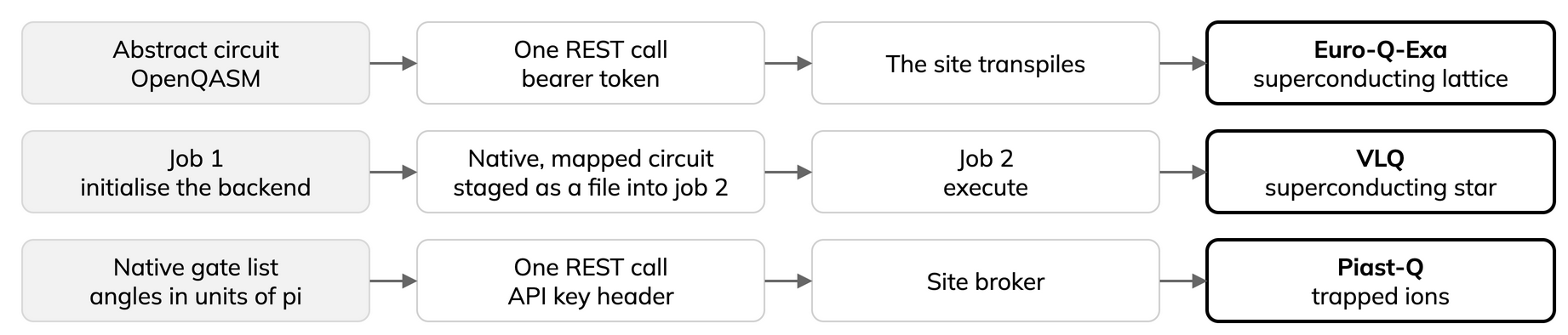
What you send and where you send it, for each of the three machines.
Note
The star topology. On VLQ every two-qubit gate locus is (qubit, resonator); there is no qubit-to-qubit coupling at all. An entangling operation between two qubits is a MOVE of one qubit’s state into the resonator, a CZ between the resonator and the other qubit, and a MOVE back. Since that site does not transpile for you, the MOVEs have to be in the circuit you send, whether you write them or a compiler inserts them. Any depth estimate you carried over from a lattice machine will not hold.
For the design, see the IQM Star paper and IQM’s MOVE gate.