B7 Read a completed shared-GPU benchmark
ALCHEMI batching versus eight native LAMMPS processes sharing one GH200 on Arrhenius or JUPITER.
Each row: eight independent silicon/MACE trajectories, NVE, 64 or 512 atoms each. The incomplete Arrhenius 4,096-atom matrix is excluded.
Recorded site runs, not your session. Cells only read checked-in CSVs: no MD, allocation or Slurm.
Sites differ in runtime and startup conditions; do not compare them as if identical.
Reference measurements
Tabs select displayed reference data only, not a backend or kernel.
One Arrhenius GH200; time to finish all eight trajectories, in seconds:
Atoms/trajectory |
ALCHEMI batch |
LAMMPS ordinary, 8 clients |
LAMMPS MPS, 8 clients |
|---|---|---|---|
64 |
18.745 |
100.010 |
88.336 |
512 |
26.599 |
114.335 |
90.782 |
One JUPITER GH200 (a full node was allocated); time to finish all eight trajectories, in seconds:
Atoms/trajectory |
ALCHEMI batch |
LAMMPS ordinary, 8 clients |
LAMMPS MPS, 8 clients |
|---|---|---|---|
64 |
76.380 |
95.733 |
73.033 |
512 |
35.166 |
115.179 |
75.696 |
All 16 JUPITER comparison rows. The private JUPITER matrix also keeps a redundant ordinary-sharing one-client row per size. The site MPS server was observed during the concurrent clients.
Whole workflow or measured MD?

Whole workflow: ALCHEMI client start until all eight finish.
Measured MD: the 200 steps after ten warmup steps, all eight together; excludes Python startup, model loading, initial forces and warmup.
Site |
Atoms/simulation |
Whole workflow, all eight (s) |
Measured MD, all eight (s) |
|---|---|---|---|
Arrhenius |
64 |
18.745 |
5.595 |
Arrhenius |
512 |
26.599 |
13.373 |
JUPITER |
64 |
76.380 |
4.571 |
JUPITER |
512 |
35.166 |
13.232 |
One run per case, not medians; sites used different runtime packaging.
JUPITER ran 64 atoms first in its job. Its long whole-workflow time is startup and setup, not slower MD (measured MD is similar); the cause (imports, filesystem caching, GPU power policy) is not isolated.
For a site-performance claim, repeat cases in varied order and report medians and ranges for both clocks.
The read-only cell below renders one full CSV. Change site to see the
other site (tabs do not change notebook variables); re-running changes no
data and runs no MD.
processes: LAMMPS client processes; ALCHEMI is one process, eight replicas.Each row: eight simulations, each 10 warmup and 200 measured steps.
Both engines: NVE velocity-Verlet, 0.1 fs; initial velocities independent, not atom-by-atom matched.
Time to finish all eight = group wall time: client startup, model loading, warmup and MD; excludes queue wait, native archive extraction and MPS controller startup.
Aggregate rate =
8 × 200 / group wall seconds: MD steps across all eight per second, not one trajectory’s speed nor a standard MD unit.
Atoms/simulation |
Method |
Clients |
Time to finish all 8 (s) |
MD steps across all 8/s |
|---|---|---|---|---|
64 |
ALCHEMI batch |
1 |
18.745 |
85.358 |
64 |
LAMMPS sequential |
1 |
690.053 |
2.319 |
64 |
LAMMPS ordinary sharing |
2 |
361.698 |
4.424 |
64 |
LAMMPS ordinary sharing |
4 |
176.423 |
9.069 |
64 |
LAMMPS ordinary sharing |
8 |
100.010 |
15.998 |
64 |
LAMMPS CUDA MPS |
2 |
339.398 |
4.714 |
64 |
LAMMPS CUDA MPS |
4 |
165.881 |
9.645 |
64 |
LAMMPS CUDA MPS |
8 |
88.336 |
18.113 |
512 |
ALCHEMI batch |
1 |
26.599 |
60.153 |
512 |
LAMMPS sequential |
1 |
716.230 |
2.234 |
512 |
LAMMPS ordinary sharing |
2 |
333.660 |
4.795 |
512 |
LAMMPS ordinary sharing |
4 |
201.097 |
7.956 |
512 |
LAMMPS ordinary sharing |
8 |
114.335 |
13.994 |
512 |
LAMMPS CUDA MPS |
2 |
351.858 |
4.547 |
512 |
LAMMPS CUDA MPS |
4 |
171.070 |
9.353 |
512 |
LAMMPS CUDA MPS |
8 |
90.782 |
17.625 |
Generate a comparison figure
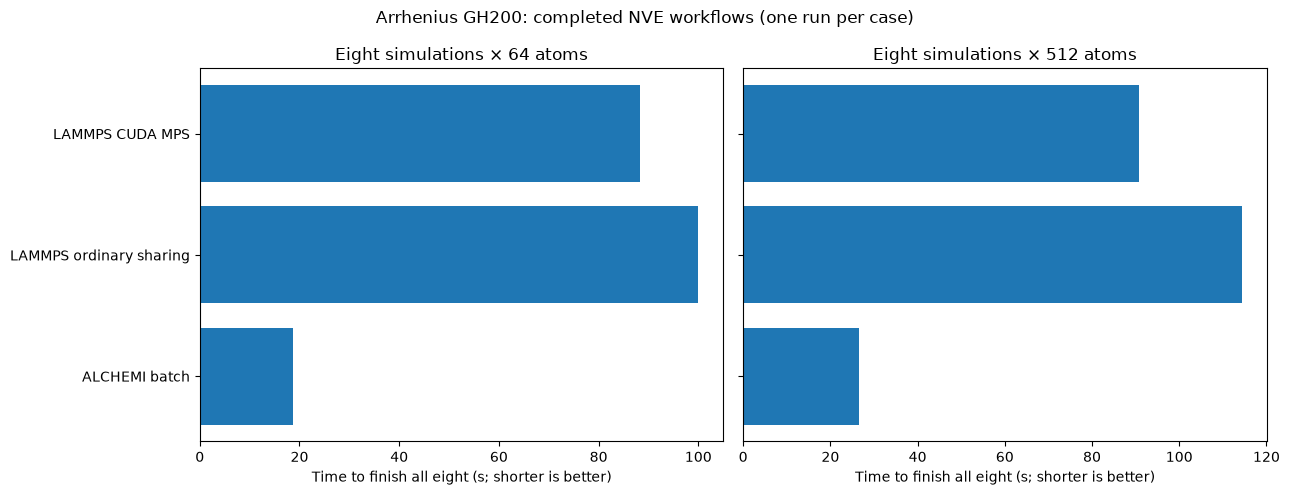
Time to finish all eight; shorter is better for this fixed work. Shows ALCHEMI and the two eight-process LAMMPS modes (ordinary, CUDA MPS); the table keeps every client count. Whole-workflow timings, not force-kernel speedups.
Interpret the measurement
Arrhenius:
ALCHEMI versus fastest LAMMPS: 18.745 s vs 88.336 s at 64 atoms (about 4.71x); 26.599 s vs 90.782 s at 512 atoms (about 3.41x).
Not a repeated-run estimate, kernel speedup, trajectory-equivalence result or GPU memory limit.
The 4,096-atom matrix timed out before its eighth row; do not extrapolate.
JUPITER:
ALCHEMI 76.380 s (64) vs 35.166 s (512): the larger case is not intrinsically faster; startup and setup dominate the first whole-workflow result (measured MD above); the precise cause is not isolated.
LAMMPS MPS 73.033 s and 75.696 s vs ordinary 95.733 s and 115.179 s.
Supports showing both modes, not a general MPS or cross-site speedup claim.
For a new comparison:
Record model and software hashes, GPU occupancy, initial positions and velocities, warmup and timed-step counts.
Repeat each case on an otherwise idle GPU; report median and range for time to finish all eight.
Compare energies and forces at matched states separately from timing.
At 64 atoms, setup and model loading weigh more than at large atom counts.