Choosing an MLIP
Objectives
Match a universal MLIP to the chemistry and DFT level it was trained on.
Pick the benchmark metric that matches the property you study.
Apply a short check protocol before trusting any model.
A universal MLIP only knows the structures and the DFT functional in its training set. The rules below are starting points, not verdicts: each is backed by a published benchmark or by a run in this lesson. Leaderboard data were accessed on 29 September 2026 and will change.
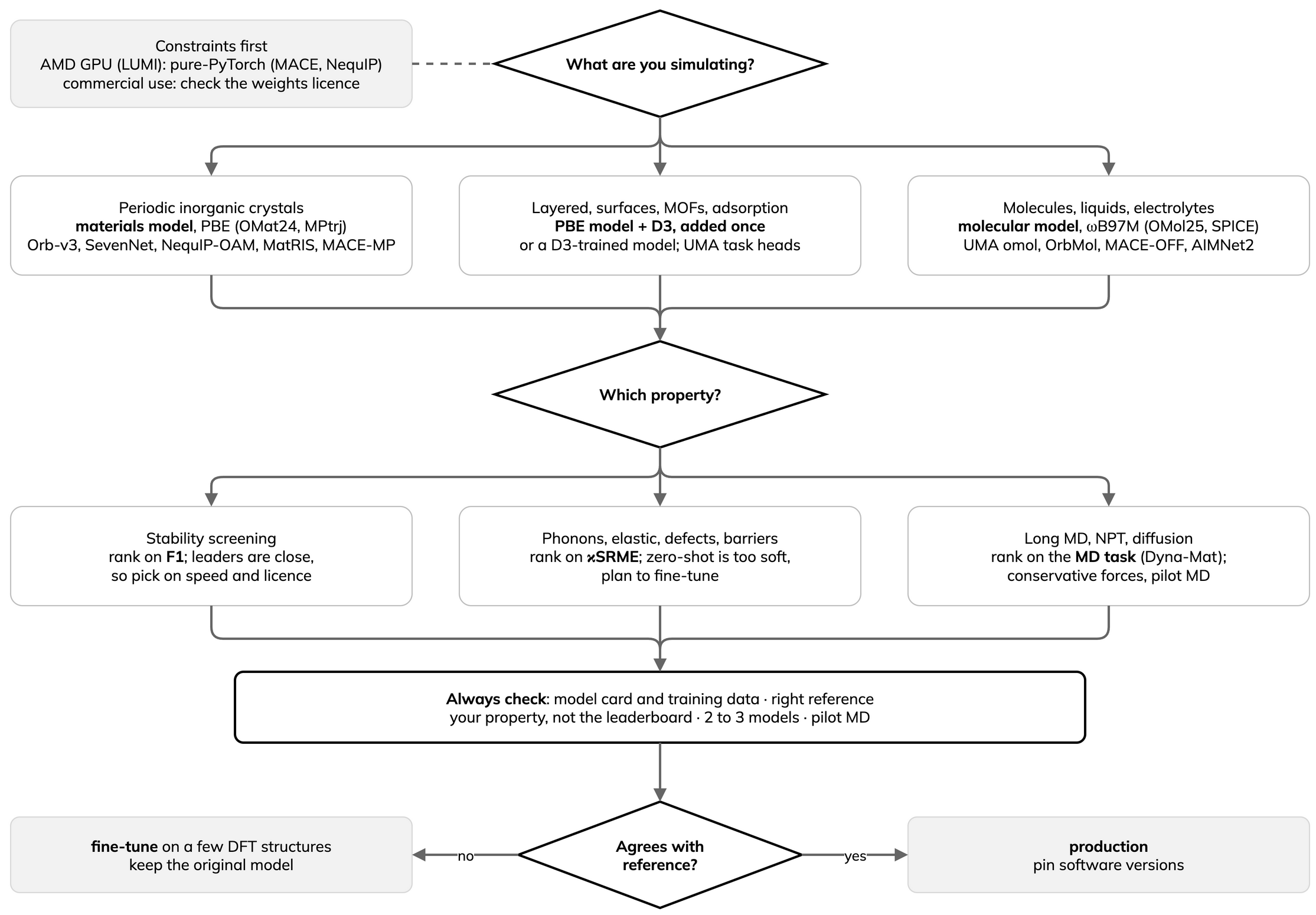
Rules of thumb
Situation |
Start with |
Why |
Sources |
|---|---|---|---|
Periodic materials (crystals, alloys, oxides): relaxation, screening and MD |
Materials models trained on OMat24 or MPtrj/Alexandria (PBE, PBE+U). Start with Orb-v3: fast, a conservative variant for MD, a D3 option for van der Waals, Apache-2.0. Also SevenNet-Omni, NequIP-OAM-XL, MatRIS-10M-OAM, MACE-MP; on LUMI NequIP-OAM or MACE; MatterSim v1 5M for large batches |
OMat24-class models reach F1 of about 0.92 to 0.93, and the top five are within 0.012 in combined score, so choose on speed, licence and hardware. Stable is not makeable: after relaxation, the best models picked the lowest-energy ordering only about 24 % of the time. In our LUMI run, Orb-v3 put a Li hop in LiFePO4 within 0.05 eV of DFT (A5 NEB: migration barriers with MLIPs). |
|
Molecules, liquids, electrolytes, biomolecules, charged or open-shell species |
Molecular models at hybrid-DFT level: UMA task |
For Na-ion electrolytes, UMA-OMol matched experimental densities with R² = 0.98, against 0.34 to 0.45 for two materials models, and some runs with those went unphysical. On SPICE molecules, UMA-m-1.1 was the most accurate, and UMA-s-1.1 and Orb-v3-omol reached chemical accuracy (below 1 kcal/mol) |
|
Layered and van der Waals materials, molecular crystals, surfaces, MOFs, adsorption |
A PBE-trained model plus D3(BJ) with PBE parameters (Orb-v3 + D3, MACE-MP with |
PBE barely binds graphite (4.40 Å, about 1 meV per C), and a PBE-trained model inherits that. In A2 Orb-v3, MatGL and dispersion, plain Orb-v3 gave 4.31 to 4.37 Å; Orb-v3 + D3 gave 3.44 Å against 3.34 Å in experiment |
|
Phonons, thermal transport, elastic constants, defects, migration barriers |
Rank on κSRME, not F1: EquiformerV3-OAM, PET-OAM-XL, GRACE-3L-OAM-L, NequIP-OAM-XL are among the lowest. Treat zero-shot values as qualitative and plan to fine-tune |
Universal models systematically soften the energy surface; a single extra data point can correct much of it. Fine-tuning cut the Mo C₁₁ error from 45.9 % to 2.6 %. Zero-shot battery migration barriers have an MAE of 0.31 eV at best; worked CI-NEB example: A5 NEB: migration barriers with MLIPs |
|
Amorphous, disordered or other out-of-distribution structures |
The largest, broadest-data models first (UMA-M-1p1 was best), compared with others; budget for fine-tuning |
Of 41 universal models, some exceeded 100 % relative energy error on amorphous carbon; only UMA-M-1p1 stayed below 15 % on all five systems. Four a-SiO₂ structures cut the error by more than 5 times |
[17] |
Long MD, NPT, pressure, density, diffusion |
Models that do well on the MD task (orb-v2, GRACE-2L-OAM, MACE-MH-1-OMAT) and conservative-force variants such as Orb-v3 |
In 15 foundation MLIPs, the tier with the lowest force error had the worst median pressure error (3.40 GPa). In a CdSe study, the model with the lowest validation error was unstable in MD |
|
Hardware and licence |
AMD MI250X (LUMI): pure-PyTorch models (NequIP/Allegro, MACE). NVIDIA (Leonardo, Arrhenius): everything. Commercial use: Orb (Apache-2.0), SevenNet, NequIP (MIT), MatRIS, PET (BSD-3). Restricted: UMA/eSEN (gated), GRACE-3L-OAM and MACE-OFF (academic), DPA4 (CC-BY-NC) |
NequIP/Allegro models were benchmarked on both A100 and MI250X. CUDA-only kernels (cuEquivariance, NVIDIA Warp in ALCHEMI) have no ROCm route. Licences come from each model card |
Always check
Read the model card: training set, reference functional (PBE, PBE+U, r2SCAN, ωB97M-V), elements covered, whether dispersion is included, and which task head to use. Mixed PBE and PBE+U training data are a likely cause of anomalies: 27 of 40 transition-metal oxide and fluoride adsorbate cells were flagged in one model [20].
Compare against the right reference. An uncorrected model should reproduce its training functional, not experiment. Add missing physics such as D3 once (A2 Orb-v3, MatGL and dispersion).
Benchmark the property class you study (equation of state, phonons, elastic constants, barriers, densities), not the headline score. The F1 and κSRME leaders differ [1]; MLIP Arena [21] and mlipbenchmarks [10] make this a few lines of code.
Run two or three models from different families or training sets. Disagreement is a warning sign.
Run a short pilot MD in the target ensemble. Check stability, one observable (pressure, density, radial distribution) and speed and GPU memory at your real system size [18].
If it is off, fine-tune on a few targeted DFT structures and keep the original model for other chemistry. In A4 Train and fine-tune a potential, 84 Li structures took TensorNet from PBE to r2SCAN with an energy error of 60 meV/atom, against 513 meV/atom when trained from scratch. Pin software versions: silent-error bugs were fixed in cuEquivariance 0.12.0, NequIP 0.19.0 and TorchSim 0.6.1 between July and September 2026.
One size does not fit all
No model leads on every metric. On Matbench Discovery, MatRIS-10M-OAM beats NequIP-OAM-XL on stability F1 (0.921 against 0.906) but has a much larger thermal-conductivity error (κSRME 0.22 against 0.13) [1]. The lowest force error did not give the best MD pressure [18], and lower energy error did not give better polymorph ranking [5]. A benchmark of 15 pretrained MLIPs concluded that “different applications will have different requirements” [10]: the most accurate model was not the fastest. Choose for your chemistry, property and hardware, then test.
Keypoints
A model knows only the chemistry and functional of its training data.
Rank models on the metric for your property, and test that property.
Compare several models; fine-tune when they miss your reference.
References
J. Riebesell et al., Matbench Discovery, Nat. Mach. Intell. 7, 836 (2025). doi:10.1038/s42256-025-01055-1; leaderboard
L. Barroso-Luque et al., OMat24. arXiv:2410.12771
B. Rhodes et al., Orb-v3. arXiv:2504.06231
S. R. Kavanagh et al., NequIP and Allegro foundation models. arXiv:2607.28461
FPBench, polymorph ranking with universal MLIPs. arXiv:2609.05714
D. S. Levine et al., OMol25. arXiv:2505.08762
D. P. Kovács et al., MACE-OFF, J. Am. Chem. Soc. (2025). doi:10.1021/jacs.4c07099
D. M. Anstine, R. Zubatyuk, O. Isayev, AIMNet2, Chem. Sci. (2025). doi:10.1039/D4SC08572H
Kumar et al., universal MLIPs for Na-ion electrolytes. arXiv:2603.20183
P. Eastman, E. Pretti, T. E. Markland, J. Chem. Theory Comput. 22, 6108 (2026). doi:10.1021/acs.jctc.6c00130
E. Hazrati, G. A. de Wijs, G. Brocks, Phys. Rev. B 90, 155448 (2014). doi:10.1103/PhysRevB.90.155448
S. Grimme, S. Ehrlich, L. Goerigk, J. Comput. Chem. 32, 1456 (2011). doi:10.1002/jcc.21759
B. Deng et al., systematic softening in universal MLIPs, npj Comput. Mater. 11, 9 (2025). doi:10.1038/s41524-024-01500-6
X. Liu et al., J. Appl. Phys. 139, 041101 (2026). doi:10.1063/5.0299305; companion study arXiv:2506.07401
LoRA fine-tuning of universal MLIPs for phonons. arXiv:2604.01017
Universal MLIPs for battery migration barriers. arXiv:2512.03642
Fragapane and Deringer, AM26 amorphous-materials benchmark. arXiv:2607.11384
Dyna-Mat, finite-temperature benchmark of foundation MLIPs. arXiv:2607.03433
MLIP stability in CdSe molecular dynamics. arXiv:2609.15299
MLIP Detective. arXiv:2609.08399
Chiang et al., MLIP Arena, NeurIPS 2025 Datasets and Benchmarks. arXiv:2509.20630
B. M. Wood et al., UMA. arXiv:2506.23971