A4 Train and fine-tune a potential
Objectives
Train a small formation-energy model and read its learning curve.
Fine-tune a PBE foundation potential on r2SCAN data.
Compare zero-shot, fine-tuned and from-scratch errors on one test set.
A1 and A2 use foundation potentials zero-shot; A3 fine-tuned one on a toy EMT set. The Background section “Pre-train, then fine-tune” gives the recipe for when that is not enough: fine-tune on a small targeted set. This page runs both halves with MatGL 4.0.3 [1], following the MatGL tutorials on formation-energy training and potential fine-tuning.
The example is a small package, examples/training:
File |
Role |
|---|---|
|
downloads data and the pretrained model (login node); writes subsets |
|
formation-energy model (MEGNet or M3GNet) |
|
zero-shot, fine-tuned and from-scratch cases |
|
loads, re-references and evaluates TensorNet potentials |
|
Lightning training loop; JSON and figures |
Formation energy
Data: Materials Project 2018.6.1 formation energies used for MEGNet [2]; a random subset of 5000 crystals (86 elements, seed 42), split 4000/500/500.
Model: MEGNet as in the MatGL tutorial (4 Å cutoff, three blocks, set2set readout);
--model m3gnetswaps in M3GNet [3].Targets standardised with the training mean and standard deviation; the checkpoint with the lowest validation loss is kept.
python -m training eform --data <SCRATCH>/mlip-training/data \
  --outdir results/eform --epochs 200
Result: one run on one MI250X GCD (LUMI), float32; 200 epochs, batch 64, learning rate 10⁻³, 460 s training.
Set |
MAE (eV/atom) |
|---|---|
training |
0.097 |
validation |
0.140 |
test |
0.137 |
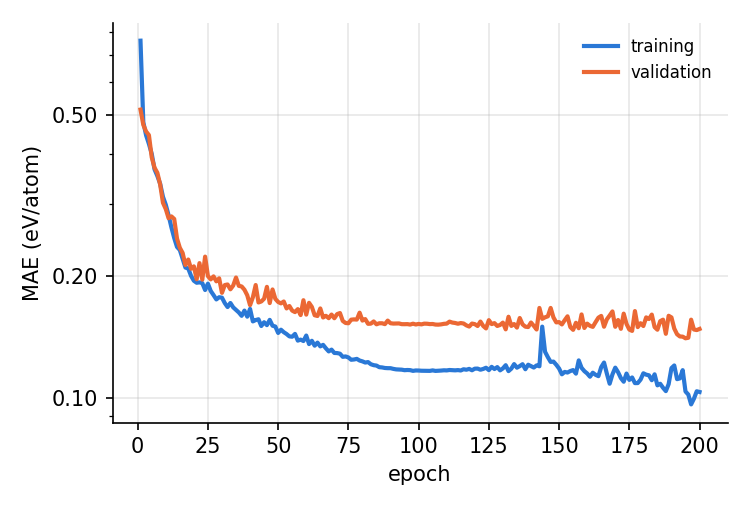
Validation error falls fast for about 50 epochs, then slowly from 0.16 to 0.14 eV/atom; the growing gap to the training error signals overfitting on 4000 crystals.
The original MEGNet paper reports 0.028 eV/atom with all 69 239 crystals [2]; 5000 crystals is a demonstration, not a converged model.
Fine-tuning a foundation potential
Start:
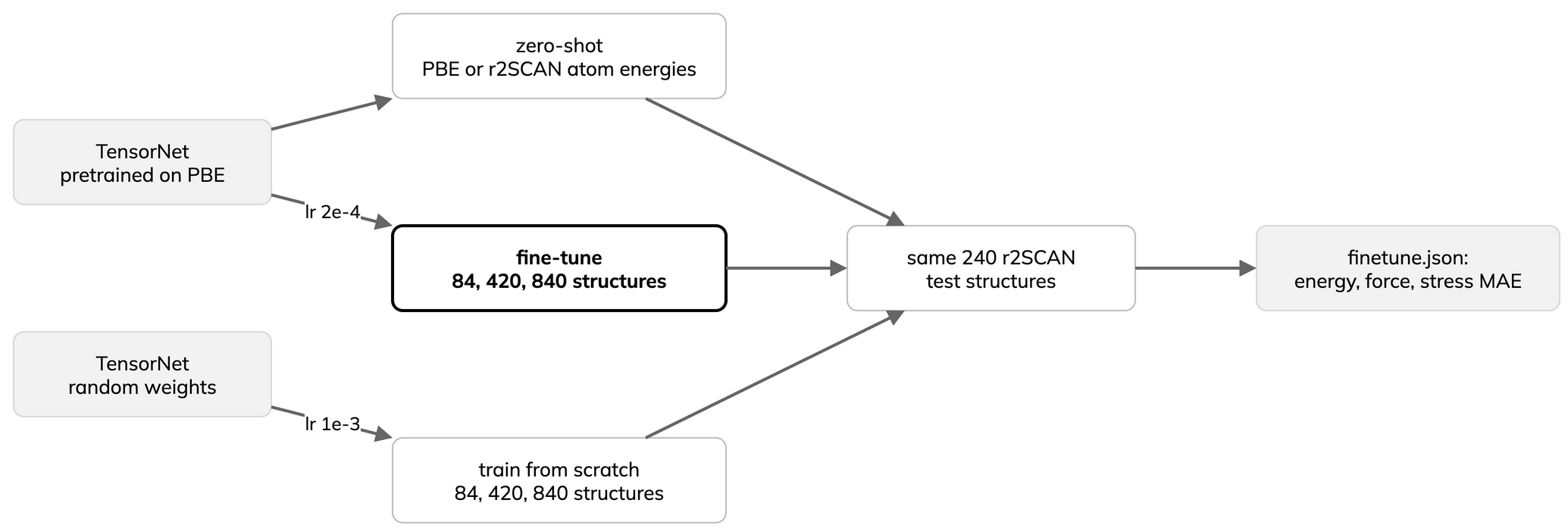
TensorNet-PES-MatPES-PBE-2025.2[4], trained on PBE energies, forces and stresses from MatPES [5].Target: r2SCAN [6], a more accurate meta-GGA. Data come from the MatPES r2SCAN test split, which the PBE model never saw: all Li-containing structures with at most 64 atoms (1200), split 840/120/240. The test set is fixed for every case.
Trained cases: 10, 50 and 100% of the training set (84, 420, 840 structures, nested); 150 epochs, batch 16, Huber loss on energy per atom, forces and stress (weight 0.1), cosine decay, seed 42. Learning rate 2 × 10⁻⁴ for fine-tuning, 10⁻³ from scratch.
Two details matter:
MatGL adds per-element reference energies to the network output. PBE and r2SCAN total energies differ by several eV/atom, so the second zero-shot case swaps in r2SCAN atom energies without touching the network; trained cases use them too.
The fine-tuned module must keep the pretrained scaling (
data_std); the MatGL default of 1.0 silently rescales every prediction.
finetune.py
25def train_case(args, kind, model, base, refs, train, val, collate):
26    lr = args.lr_finetune if kind == "fine-tuned" else args.lr_scratch
27    module = PotentialLightningModule(
28        model=model, element_refs=refs, data_mean=base.data_mean, data_std=base.data_std,
29        stress_weight=args.stress_weight, loss="huber_loss", lr=lr, decay_steps=args.epochs,
30    )
31    train_l, val_l = loaders(train, val, None, collate, args.batch_size)
32    start = time.perf_counter()
33    curve = fit(module, train_l, val_l, epochs=args.epochs, outdir=args.outdir,
34                name=f"{kind}-{len(train)}", accelerator=args.accelerator, seed=args.seed)
35    return module.model, {"lr": lr, "train_wall_s": round(time.perf_counter() - start, 1), "curve": curve}
potential.py
24def with_refs(base: Potential, refs: np.ndarray) -> Potential:
25    """Same network, different isolated-atom energies."""
26    return Potential(model=base.model, element_refs=refs, data_mean=base.data_mean, data_std=base.data_std)
27
28
29def fresh_model(base: Potential) -> torch.nn.Module:
30    """Same architecture and hyperparameters, random weights."""
31    return type(base.model)(**base.model._init_args).to(torch.get_default_dtype())
32
33
Result: one run on one MI250X GCD (LUMI), float64; test set of 240 structures, lower is better.
Case |
Training structures |
Energy (meV/atom) |
Force (meV/Å) |
Stress (GPa) |
Training (s) |
|---|---|---|---|---|---|
zero-shot (PBE) |
0 |
7949.7 |
148.2 |
1.19 |
|
zero-shot, r2SCAN atom energies |
0 |
165.9 |
148.2 |
1.19 |
|
fine-tuned |
84 |
60.4 |
127.8 |
0.75 |
117 |
from scratch |
84 |
512.7 |
427.0 |
2.97 |
117 |
fine-tuned |
420 |
82.7 |
120.1 |
0.70 |
425 |
from scratch |
420 |
282.9 |
406.4 |
2.63 |
428 |
fine-tuned |
840 |
51.8 |
112.0 |
0.63 |
798 |
from scratch |
840 |
222.5 |
339.6 |
2.37 |
805 |
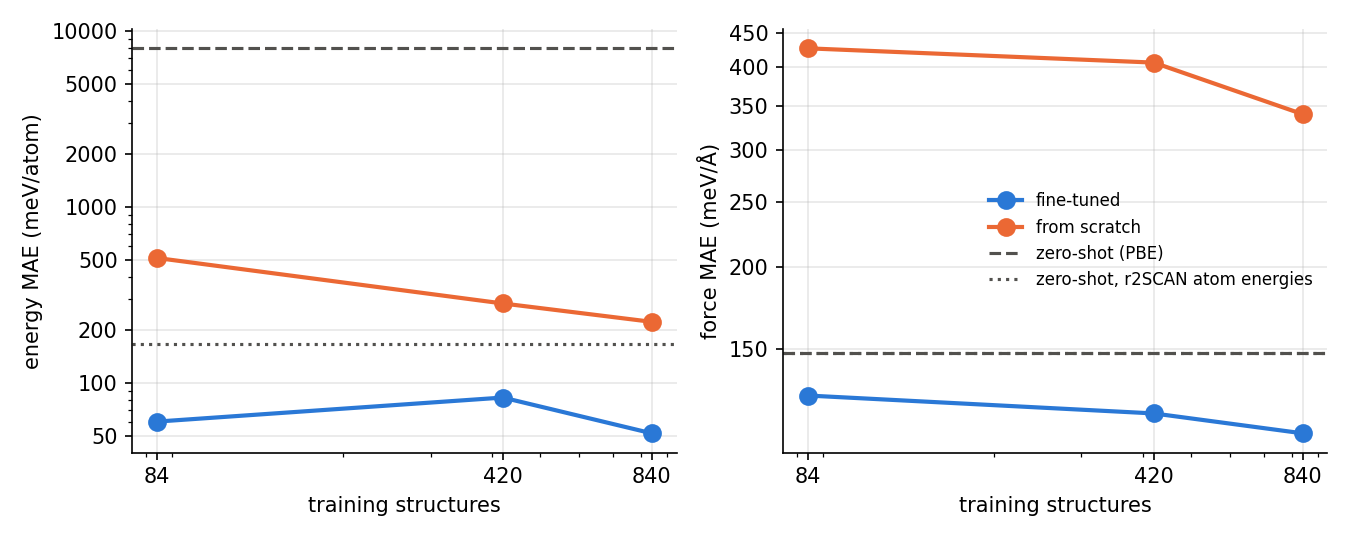
Re-referencing alone takes the zero-shot energy error from 7950 to 166 meV/atom; forces and stresses do not depend on atom energies. The raw PBE row measures the functional gap, not the model.
Fine-tuning beats training from scratch at every size: energy 3 to 8 times lower, force about 3 times, stress about 4 times. With 84 structures, fine-tuning already beats scratch with 840.
Forces improve steadily with data (128, 120, 112 meV/Å). The 420-structure energy (83) is worse than the 84-structure one (60): one seed and one split, so this is noise, not a trend.
This matches the Background section qualitatively: a foundation model is a data-efficient start, and fine-tuning moves it to a new level of theory. The fine-tuned model is specialised to Li compounds at r2SCAN level; keep the original for other chemistry.
Run on LUMI
On a login node, build a virtual environment on top of the CSC ROCm PyTorch module and download everything once (about 1.3 GB):
export MLIP_LESSON_ROOT=<SCRATCH>/mlip-hands-on
export MLIP_TRAINING_DIR=<SCRATCH>/mlip-training
bash $MLIP_LESSON_ROOT/scripts/lumi-training-setup.sh
Submit one job for both examples on one GCD (MLIP_TASKS=finetune runs one):
sbatch --account=<PROJECT> --export=ALL \
  $MLIP_LESSON_ROOT/scripts/lumi-training.sbatch
Results go to $MLIP_TRAINING_DIR/results-<jobid>/{eform,finetune} as JSON
and PNG. The fine-tuning job took 46 min.
Note
On LUMI with torch 2.7.1+rocm6.2.4, torch.det and Tensor.prod fail in
float32 (error 209); float64 works. The MatGL potential calls torch.det
for the cell volume in its stress, so the job script sets
MLIP_FLOAT_BITS=64 (same as --float-bits 64) for both tasks. The
float32 MEGNet result above is from an earlier run, before that setting;
the current job trains MEGNet in float64 too, so its numbers can differ
slightly.
To check the code on a laptop CPU first, use a few structures and two epochs:
cd examples
uv run --with matgl==4.0.3 --with pandas --with matplotlib \
  python -m training prefetch --data training_data --skip-eform --n-pes 60
uv run --with matgl==4.0.3 --with pandas --with matplotlib \
  python -m training finetune --data training_data --accelerator cpu \
  --epochs 2 --fractions 0.5 1.0
This tests the plumbing only.
Keypoints
Fine-tuning a foundation potential on a few hundred structures beats training from scratch several times over.
When the functional changes, change the atom reference energies and keep the pretrained scaling.
Evaluate every case on the same held-out test set; one run is one sample.
References
T. W. Ko et al., Materials Graph Library (MatGL). arXiv:2503.03837
C. Chen et al., MEGNet, Chem. Mater. 31, 3564 (2019). doi:10.1021/acs.chemmater.9b01294
C. Chen and S. P. Ong, M3GNet, Nat. Comput. Sci. 2, 718 (2022). doi:10.1038/s43588-022-00349-3
G. Simeon and G. De Fabritiis, TensorNet. arXiv:2306.06482
A. D. Kaplan et al., MatPES. arXiv:2503.04070
J. W. Furness et al., r2SCAN, J. Phys. Chem. Lett. 11, 8208 (2020). doi:10.1021/acs.jpclett.0c02405