Universal MLIPs on HPC: hands-on
Machine-learned interatomic potentials (MLIPs) give near-DFT energies and forces at a fraction of the cost. Universal (foundation) MLIPs are trained once across the periodic table, then used directly or fine-tuned. On HPC, GPU inference dominates, so GPU placement sets throughput.
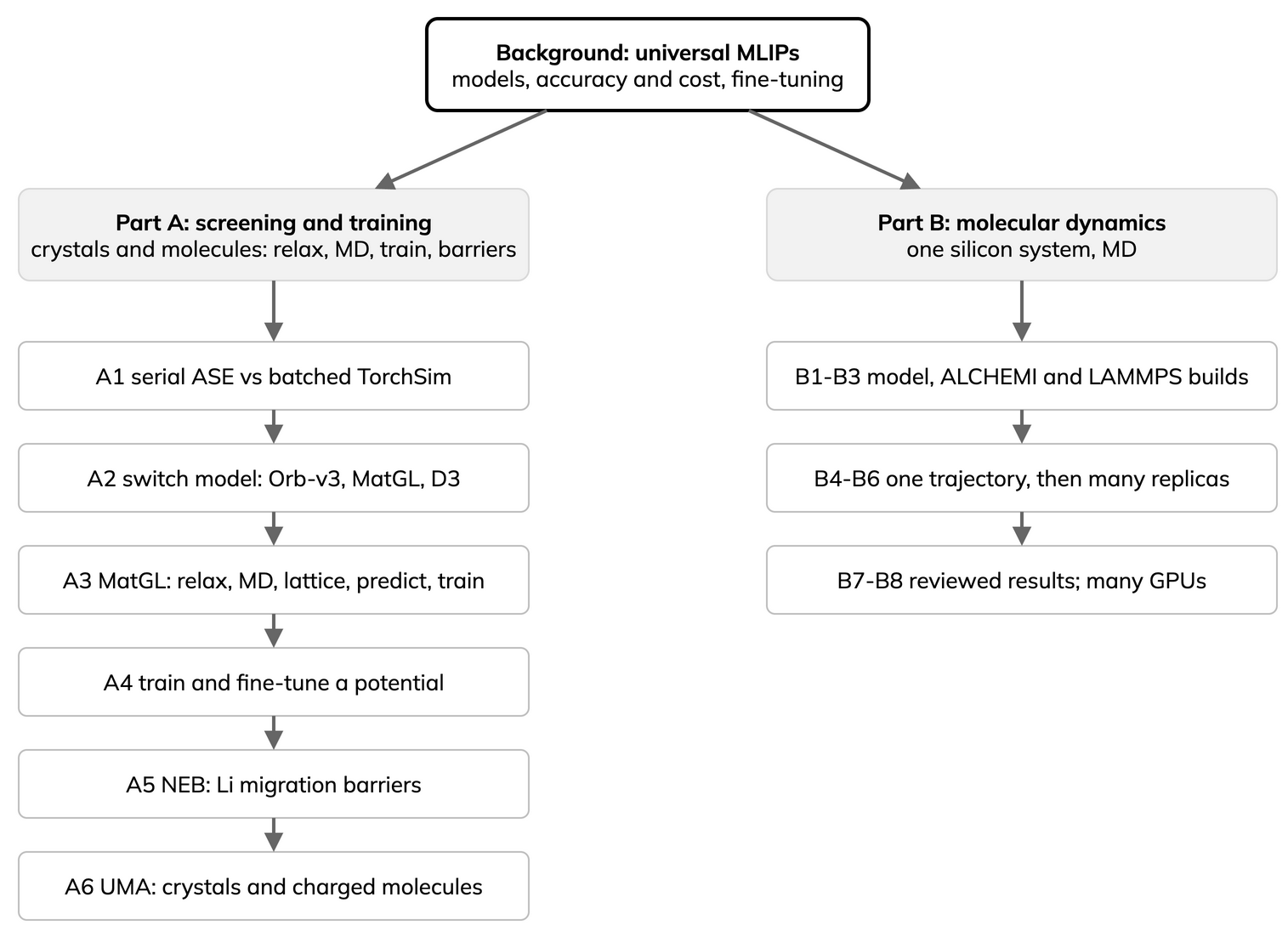
Part A: relax many crystals in one batched TorchSim call versus serial ASE, with MACE-MP and Orb-v3; MatGL relaxation, MD and a lattice benchmark; then train and fine-tune a potential, and find a Li migration barrier with CI-NEB; compare Orb-v3, OrbMol and UMA on crystals and on molecules with charge and spin.
Part B: silicon MD with MACE-MP in ALCHEMI Toolkit and LAMMPS, from one trajectory to many replicas and GPUs.
New to MLIPs? Start with Background: universal MLIPs.
Webinar slides: Webinar slides (PDF).
Source, scripts and job files: GitHub.
Contact and access support: training@enccs.se; compute and AI support from Sweden AI Factory; upcoming events and lessons.
Prerequisites
Basic Python and the command line.
To run the examples: access to a GPU system such as LUMI, Leonardo or Arrhenius (see Before you start). To read the saved results: nothing.
Background
Setup
Part A: screening and training
Part B: molecular dynamics
Run the examples in order, or use the setup pages to prepare artifacts in advance. Each runnable section shows its inputs and a small result table; the reviewed-results page keeps the repeated measurements separate from a single notebook run.
- B1 The MACE potential and the two MD engines
- B2 Build the ALCHEMI image
- B3 Build native LAMMPS with ML-IAP, Kokkos, and MPI
- B4 Simulate silicon with MACE
- B5 Batch independent trajectories on one GPU
- B6 Run the same silicon case with LAMMPS
- B7 Read a completed shared-GPU benchmark
- B8 One silicon simulation on more than one GPU
Reference
Learning outcomes
By the end of this lesson, learners can:
explain what a universal MLIP learns and where its accuracy comes from;
relax and simulate structures with a foundation model, batched on a GPU;
fine-tune a model on a small targeted dataset;
compute a migration barrier with CI-NEB and judge it against DFT;
run one model on crystals and on molecules with charge and spin;
choose a model for a task and check it before trusting it.
Acknowledgements




EuroCC 3 has received funding from the European High-Performance Computing Joint Undertaking (JU) under Grant Agreement No. 101306701. The JU receives support from the European Union’s Digital Europe Programme and Germany, Albania, Austria, Belgium, Bosnia and Herzegovina, Bulgaria, Croatia, Cyprus, Czechia, Denmark, Estonia, Finland, France, Greece, Hungary, Iceland, Ireland, Italy, Latvia, Lithuania, Luxembourg, Malta, Montenegro, the Netherlands, North Macedonia, Norway, Poland, Portugal, Romania, Serbia, Slovakia, Slovenia, Spain, Sweden, Türkiye, and Kosovo.
Funded by the European Union. Views and opinions expressed are however those of the author(s) only and do not necessarily reflect those of the European Union or EuroHPC Joint Undertaking. Neither the European Union nor the EuroHPC Joint Undertaking can be held responsible for them.
ENCCS has also received national funding through Vinnova and the Swedish Research Council (VR).
HPC in Europe is the umbrella brand uniting Europe’s high-performance computing initiatives across 36+ countries.
The project is supported by the European High-Performance Computing Joint Undertaking and its members.
Licence
Text, figures made for this lesson and other pedagogical material: CC BY-SA 4.0 (LICENSE).
Source code and code snippets: MIT (LICENSE.code).
Figures reused from publications keep the licence given in their caption; third-party components are listed in THIRD_PARTY.md.
Webinar slides: CC BY 4.0.
To cite this lesson, use CITATION.cff.