B8 One silicon simulation on more than one GPU
How many GPUs for one large molecular-dynamics (MD) run? Ask: does it fit, how long does it take, do extra GPUs save enough time. Measured LAMMPS/MACE runs on one GH200 node on Arrhenius or JUPITER. Not the same as running eight independent simulations on one GPU.
Start with one GPU
Preliminary one-GH200 size sweeps, after ten warmup steps. Each row is one run of 100 measured steps, not a median. The tabs select displayed site evidence; they do not change a notebook kernel.
Silicon atoms |
Time for 100 measured MD steps |
|---|---|
512 |
35.4 s |
8,000 |
43.7 s |
32,768 |
117.1 s |
Silicon atoms |
Time for 100 measured MD steps |
|---|---|
512 |
30.6 s |
8,000 |
43.4 s |
32,768 |
120.2 s |
Full four-GH200 Booster node allocated, one GPU used. Not a controlled cross-site comparison.
Capacity probes, pinned model, ten measured MD steps:
One GH200 completed 39,304 silicon atoms on each site.
46,656 atoms (next cubic size): CUDA out-of-memory on each site (JUPITER during the two-step warmup, not a completed MD run).
Brackets the tested workload on each site, not a maximum for every model or trajectory.
Separate native runner from the MPI jobs below; do not combine into one speedup.
Says nothing about the largest system four GPUs can run together.
Does adding GPUs finish the same system sooner?
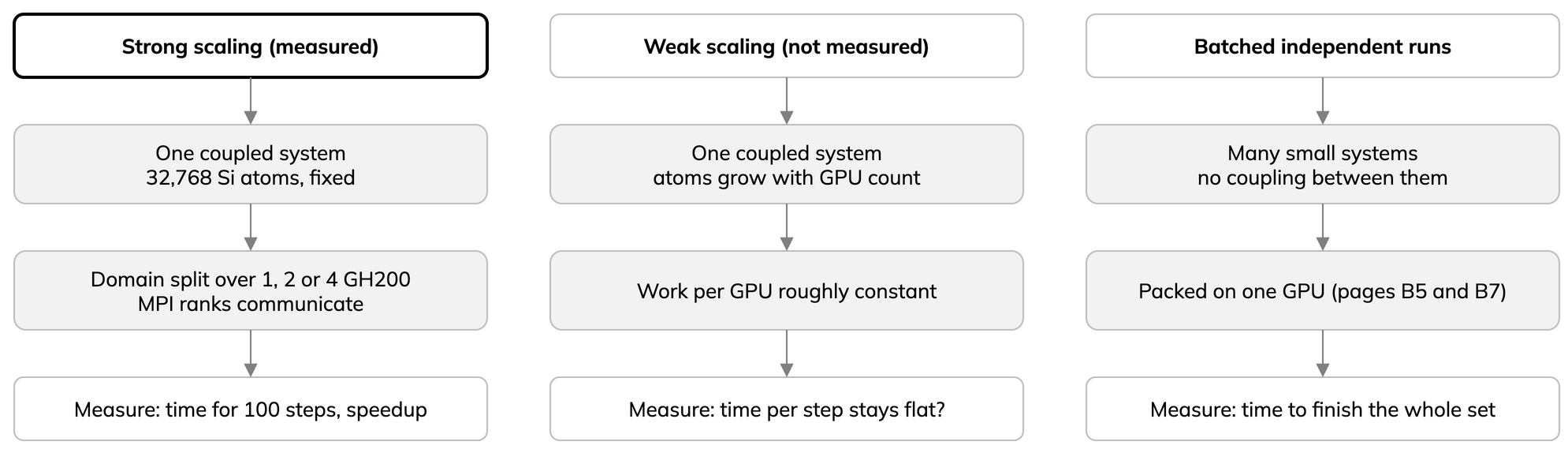
Strong scaling: fixed atom count, same coupled system, more GPUs. One 32,768-atom silicon system split over one, two or four GH200s in one node; 100 cold MD steps, 0.1-fs timestep, same MACE model. Median of three completed repetitions per GPU count.
GH200 GPUs |
Median MD time for 100 steps |
Speedup over one GPU |
|---|---|---|
1 |
119.8 s |
1.00× |
2 |
78.4 s |
1.53× |
4 |
50.8 s |
2.36× |
GH200 GPUs |
Median MD time for 100 steps |
Speedup over one GPU |
|---|---|---|
1 |
122.6 s |
1.00× |
2 |
73.4 s |
1.67× |
4 |
47.7 s |
2.57× |
Full Booster node for all GPU counts. One visible GPU per MPI rank; duration is the slowest rank’s.
Four GPUs finished this short workload sooner on both sites, but not four times sooner. Arrhenius: 4 × 50.8 s ≈ 203 GPU-seconds versus about 120 on one GPU. Trade waiting time against GPU use. Application timings, not scheduler charges.
Caveats:
Arrhenius timing covers LAMMPS
run 0plus 100 steps; excludes queue wait, process startup and extraction of the native runtime archive.Rank counts and Langevin random streams differ: not identical trajectories or proven scientific agreement.
Three short samples per site: limited variation, not a long production rate.
Different runtime stacks: no Arrhenius-versus-JUPITER hardware ranking.
Reviewed job template for the 32,768-atom case:
Check account, partition, time, memory and GPU request against the current site before any manual submission.
For two or four GPUs, change MPI rank, GPU, CPU and memory requests together and review separately.
Opening this page or running a notebook cell submits nothing.
Warning
Do not treat sbatch --test-only as proof that a reservation or allocation
will actually run. Verify current site policy and the real job outcome.
lammps-mpi-size-benchmark.sbatch
 1#!/bin/bash
 2#SBATCH --nodes=1
 3#SBATCH --ntasks=1
 4#SBATCH --ntasks-per-node=1
 5#SBATCH --gpus-per-node=1
 6#SBATCH --cpus-per-task=72
 7#SBATCH --mem=100G
 8#SBATCH --time=00:15:00
 9#SBATCH --network=single_node_vni
10# Cold 32,768-atom / 100-step coupled-MD gate. Override ranks, GPUs and
11# memory together for separately reviewed 2- or 4-GH200 submissions.
12set -euo pipefail
13umask 077
14here=$(pwd -P)
15: "${MLIP_MPI_ARCHIVE:?verified MPI archive required}"
16: "${MLIP_MPI_ARCHIVE_SHA256:?exact archive hash required}"
Read the complete job script before adapting or submitting; the excerpt hides setup, checks and launch.
What about weak scaling and larger systems?
Weak scaling (atoms grow with GPUs, roughly constant work per GPU): not measured for one/two/four GPUs of this LAMMPS/MACE system; the strong-scaling table is not a weak-scaling result.
Four-GPU atom limit not measured. To bound it: predeclare increasing sizes, fix model and run settings, record successes and explicit memory failures, stop at the first resource limit.
Four GPUs are not one pooled memory; domain decomposition adds per-rank data and communication. Largest completed case = tested workload, not an intrinsic limit. See Limits and provenance.
ALCHEMI Toolkit
DomainParallelalso splits one system across GPUs, but its multi-GPU records show an unresolved rank-count energy difference: no cross-engine scaling claim.JUPITER has a separate per-rank GPU binding and native MPI setup. Eight GPUs on two nodes passed a short functional check (ten steps, 512 atoms): not a multi-node scaling study, do not plot as speedups.
Many small independent runs: see B5 Batch independent trajectories and the reviewed eight-simulation comparison; the measure is time to finish the set, not scaling of one simulation.